

HOW TO SPOT THE SIGNS
Suicide is rarely caused by a single risk factor.
It is best understood in the context of an individual’s circumstances, both current and across their lifetime. Whilst some groups may experience a higher level of risk, it is important not to generalise. Suicide thoughts and behaviours can affect anyone at any stage of life.
Most risk factors do not lead directly to thoughts of suicide or suicide behaviours. However, certain experiences and circumstances can increase emotional distress and vulnerability. Recognising these challenges can help individuals and organisations provide support earlier and more effectively.
Sport can also play a protective role by providing routine, purpose, connection and a sense of belonging, all of which can help reduce risk and support wellbeing.1
When considering suicide risk in sport, it can be helpful to think about three areas:
If someone is experiencing any of the following social, emotional or physical health issues:
- Depression or anxiety
- Substance misuse
- Gambling
- Chronic pain, injury and long-term rehabilitation
- Traumatic brain injury2,3
- Disordered eating
- Social isolation
- Gender and sexual identity
- Identity solely tied to sport
- Sexual and physical abuse4
- Bereavement by suicide
If someone is experiencing periods of uncertainty, loss or significant change, such as:
- Deselection
- Academy release
- Injury and long rehabilitation
- Contract non-renewal
- Retirement (planned or sudden)
- Criticism from public, club or media
- Online abuse
- Financial instability
- Redundancy from sporting roles
- Disciplinary procedures
- Pregnancy
If the culture around someone includes:
- Stigma around being vulnerable
- Discrimination and bullying
- Poor safeguarding practices
- Masculinity norms suppressing emotion and discouraging help-seeking
- Performance-over-person culture
- Lack of confidential support (which can be a barrier to help-seeking )
- Absence of structured or co-ordinated transition planning (e.g. if someone is dropped from an academy or team, is injured, moves teams, or retires)
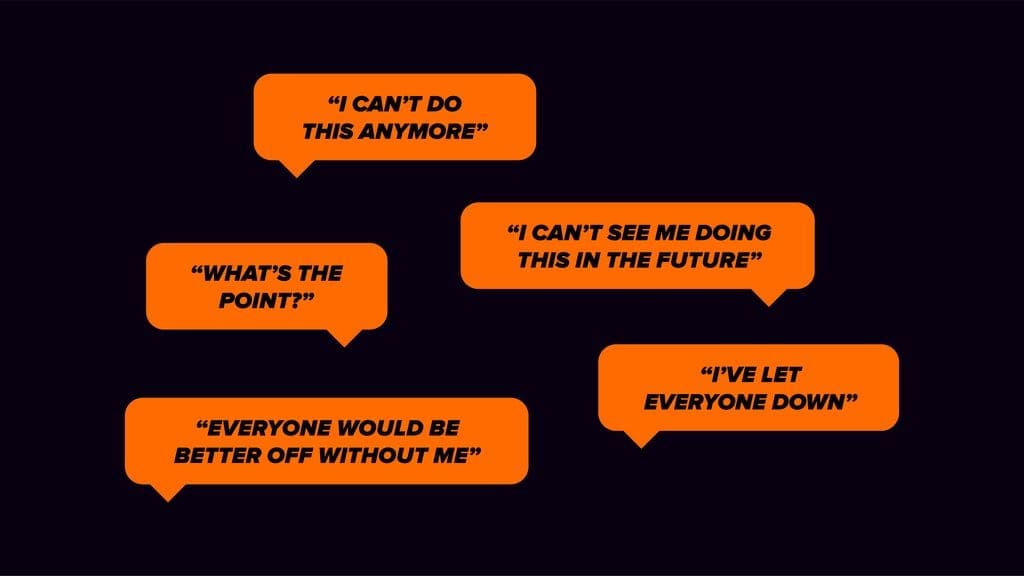
Even subtle changes in behaviour, mood or circumstances can indicate that someone needs support. Distress or thoughts of suicide can appear as a change in attitude, low motivation or worsening performance. All expressions of hopelessness or feeling like a burden should be taken seriously. People can show distress in different ways if you notice a change – ask.

WHAT SOMEONE MIGHT SAY
WHAT SOMEONE MIGHT DO
Withdraw from the team or matches
Miss training without explanation
Express anger, frustration or fear
Have emotional outbursts or flatness
Play recklessly or take unusual risks
Give possessions or kit away
Appear suddenly calm after distress
Talk about being a burden or having no future
Increase alcohol or substance use
Use dark humour
Leave messages of goodbye or express distress on social media
1. Huo M, Yang Z, Yang L and Chen S. (2024) Can sports participation be a protective factor against suicide-related outcomes in adolescents: a systematic review. Frontiers in Psychology, 15, Article 1341795. https://doi.org/10.3389/fpsyg.2024.1341795
2. Liao, M., Hu, E., & Liu, K. (2025). Risk of suicidal behaviors following sport-related and non-sport-related concussion: a systematic review and meta-analysis. BMC psychiatry, 25(1), 1072. https://doi.org/10.1186/s12888-025-07509-5
3. Madsen, T., Erlangsen, A., Orlovska, S., Mofaddy, R., Nordentoft, M., & Benros, M. E. (2018). Association Between Traumatic Brain Injury and Risk of Suicide. JAMA, 320(6), 580–588. https://doi.org/10.1001/jama.2018.10211
4. Timpka, T., Spreco, A., Dahlstrom, O., Jacobsson, J., Kowalski, J., Bargoria, V., Mountjoy, M., & Svedin, C. G. (2021). Suicidal thoughts (ideation) among elite athletics (track and field) athletes: associations with sports participation, psychological resourcefulness and having been a victim of sexual and/or physical abuse. British journal of sports medicine, 55(4), 198–205. https://doi.org/10.1136/bjsports-2019-101386
WHAT TO DO NEXT

Keep up to date
Subscribe for regular updates on new information and resources.