
UNDERSTANDING SUICIDE
TO BE PROACTIVE IN PREVENTING SUICIDE, WE NEED TO UNDERSTAND IT.
While suicide is relatively rare, exposure to suicide is much more common than most people in sport realise. Statistics show that within any sports organisation, team, or setting, there are likely to be people who have struggled themselves, supported someone else, or been affected by suicide.
IN NEED OF SUPPORT?
Hub of Hope is the UK’s largest directory of mental health services.
DID YOU KNOW?
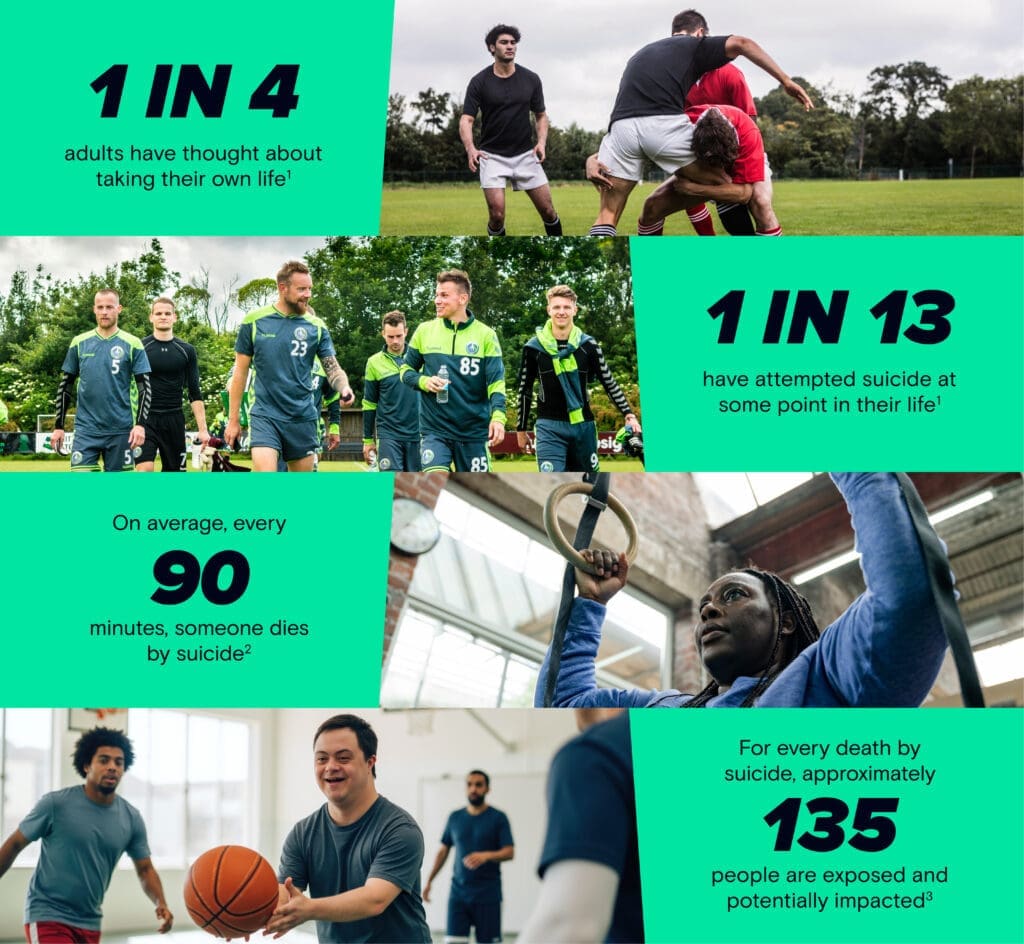
The impact of a suicide can extend far beyond immediate family and friends. For people who are highly involved in sport or their community, a wider network of teammates, colleagues, volunteers and supporters may also be affected.
Those who are bereaved by suicide are also at a higher risk of struggling with their own mental health, including thoughts of suicide.4 Because sport often involves close team bonds and strong social connections, the loss of one member can have a significant emotional impact on the whole community.
Every suicide is a tragic and often preventable loss of life. There is rarely a single cause. Instead, suicide usually results from a complex mix of factors and life experiences.5
The culture and environments around sport can influence both suicide risk and whether someone feels able to speak up and seek support.

WORDS MATTER
Respectful, neutral, non-judgemental language can reduce stigma, encourage people to seek help, and lead to safer and more progressive conversations. Try to do this across all forms of communication and conversations to create a space where people feel safe to talk openly. Just remember that it is always more important to talk and have The Conversation than to use the ‘right’ words.
TRY TO AVOID
Committed suicide
WHY
This links back to when suicide was a crime.
TRY TO USE
Ended / took their own life
Died by suicide

MYTH VS REALITY
Suicide, thoughts of suicide, and suicide behaviours are often surrounded by misconceptions, misunderstandings, and uncertainty. Having the right knowledge can make a real difference.
There is no evidence that asking someone directly if they are thinking about suicide accelerates those thoughts.6 In fact, it opens up a conversation that can help someone feel heard, less alone, and more willing to seek support. A simple, direct conversation could be the first step towards getting help.
High performance may increase pressure and expectation, and failure can create distress that is amplified by being in the public eye.
Someone can appear successful, perform well, and still be struggling with thoughts of suicide. Everyone is affected differently. We don’t always know what someone has been through to reach this stage, or what’s happening in other parts of their life. Never assume and always ask how someone is.
Many people who die by suicide have expressed the wish to die. We want those who are experiencing thoughts of suicide to seek help and attention. So it is dangerous to then use this negative stereotype. It can stop people looking for and finding support when they most need it.
Men do seek help,7 but it is too often misunderstood or dismissed. The competitive nature of sport can create fear that speaking out could have repercussions. Sports organisations need to create a culture where people feel safe to speak openly about their thoughts without feeling judged, knowing that they are being listened to and will be supported.
Suicide does not just affect one type of sport or person. It can affect anyone. The reasons someone is struggling may have nothing to do with sport. Rather than making assumptions, listen carefully and respond to the person in front of you.
A death by suicide can affect anyone involved in sport, including teammates, coaches, and staff. While some people may find it difficult to talk about their loss, many value the opportunity to share memories. Listening, showing understanding, and offering support can make a real difference.
For many people, self-harm is a way of coping with distress rather than an attempt to end their life.1 However, for some, self-harm may be linked to thoughts of suicide or a desire to die. People self-harm for different reasons and these may change, so it is important not to make assumptions, to listen and to ensure they receive the right support in all circumstances.
Experiencing thoughts of suicide needs to be taken seriously, and those around you should always prioritise your safety. Just like how you would need time to recover from a physical injury, the right choice may be to take a break. This does not mean you won’t get back to your sport, after getting the right support. What it does mean is that you will be able to show up at your best.
1. Butt, S., Randall, E., Morris, S., Appleby, L., Hassiotis, A., John, A., McCabe, R., & McManus, S. (2025) Suicidal thoughts, suicide attempts and non-suicidal self-harm. In Morris, S., Hill, S., Brugha, T., McManus, S. (Eds.), Adult Psychiatric Morbidity Survey: Survey of Mental Health and Wellbeing, England, 2023/4. NHS England. https://digital.nhs.uk/data-and-information/publications/statistical/adult-psychiatric-morbidity-survey/survey-of-mental-health-and-wellbeing-england-2023-24/suicidal-thoughts-suicide-attempts-and-self-harm#4-6-citation
2. UK Parliament House of Commons Library (2026) Suicide Statistics. https://commonslibrary.parliament.uk/research-briefings/cbp-7749/
3. Cerel, J., Brown, M.M., Myfanwy, M., Singleton, M., van de Venne, J., Moore, M., and Flaherty, C. (2019) How many people are exposed to suicide? Not six. In: Suicide and Life-Threatening Behavior. Wiley. April 2019, 49(2), 341–626. https://pubmed.ncbi.nlm.nih.gov/29512876/
4. McDonnell, S., Hunt, I. M., Flynn, S., Smith, S., McGale, B., & Shaw, J. (2020). From grief to hope: The collective voice of those bereaved or affected by suicide in the UK. Suicide Bereavement UK. https://suicidebereavementuk.com/key_document/from-grief-to-hope/
5. World Health Organization (2025) Suicide Factsheet. https://www.who.int/news-room/fact-sheets/detail/suicide
6. Dazzi, T., Gribble, R., Wessely, S., & Fear, N. T. (2014). Does asking about suicide and related behaviours induce suicidal ideation? What is the evidence?. Psychological medicine, 44(16), 3361–3363. https://doi.org/10.1017/S0033291714001299
7. John, A., Delpozo-Banos, M., Gunnell, D., Dennis, M., Scourfield, J., Ford, D., Kapur, N.,And Lloyd, K. (2020) Contacts with primary and secondary healthcare prior to suicide: Case-control whole-population-based study using person-level linked routine data in Wales, UK, 2000–2017. In: British Journal of Psychiatry. Cambridge University Press. December 2020, 217(6), 717–724. https://pubmed.ncbi.nlm.nih.gov/32744207/
to what extent has this information improved your understanding of the topic of suicide?
FOR EVERYONE


FREE DIGITAL DOWNLOADS
Download the Toolkit PDF and the British Standard below.